
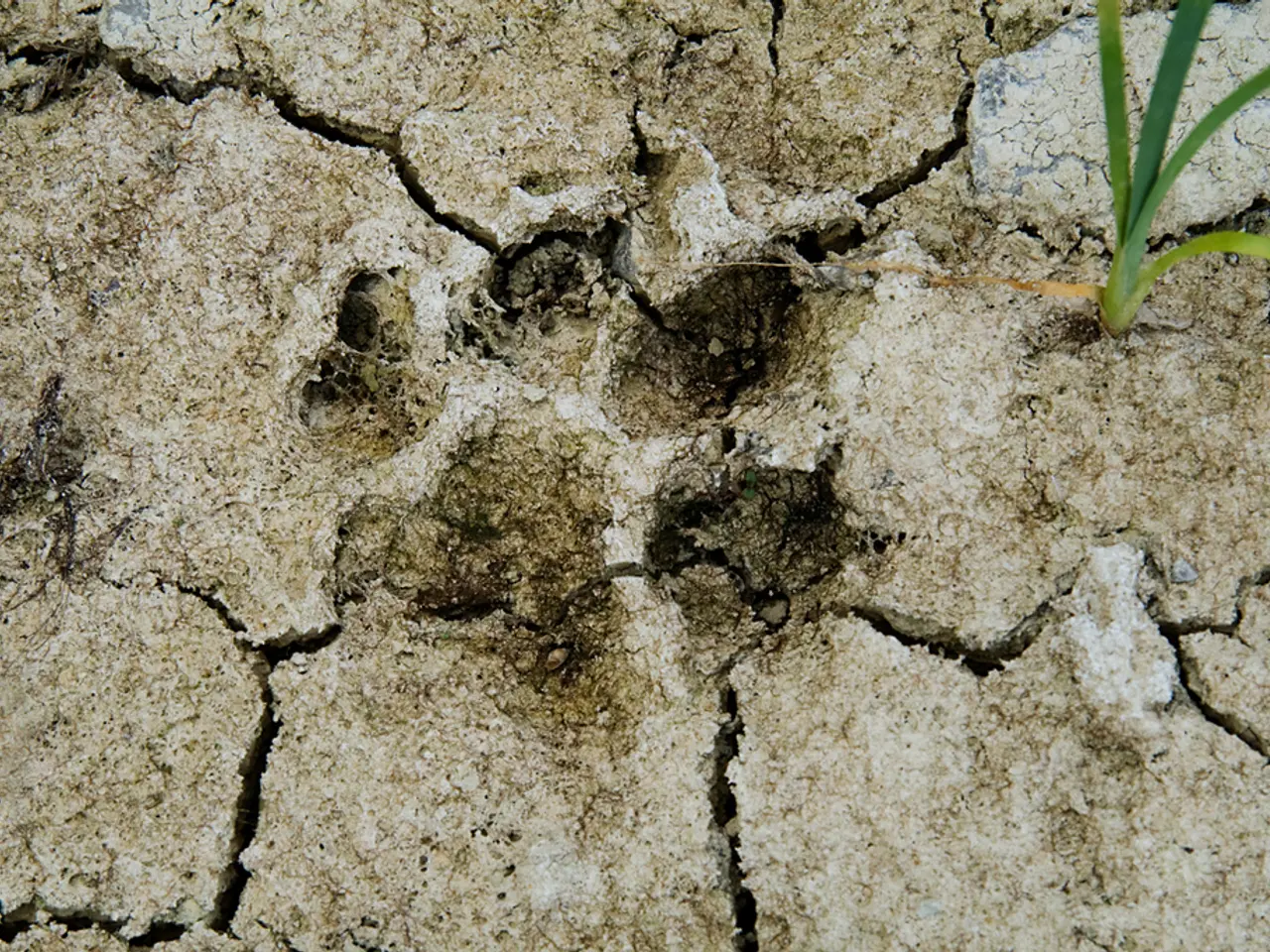
Investigating Segamat cracks due to drought and geological factors in relation to recent earthquakes
In the small town of Segamat, Malaysia, a joint team of researchers from the Johor Minerals and Geosciences Department (JMG), MetMalaysia, and Universiti Teknologi Malaysia (UTM) are currently conducting an investigation into a series of recent tremors and ground cracks that have been causing concern among the local community.
The investigation was prompted by a visit from JMG director Noorazhar Ngatimin to a resident's farm in Jalan Buloh Kasap, Batu 2, where cracks were reported to have formed following a tremor at 7.29 am on an unspecified date. The most recent tremor in Segamat possibly related to the ground fissures occurred on September 5, 2025, at 01:05 (GMT+8).
Initial inspections with resistivity-type geophysical equipment only provide a basic overview of the conditions below the ground surface, according to Noorazhar Ngatimin. This initial data obtained from the resistivity study only provides a basic understanding of soil type, thickness, and the structure of cracks, but cannot determine the time of their formation.
Despite this, Noorazhar Ngatimin has stated that the current dry weather conditions might have contributed to the formation of ground cracks in Segamat. He also suggests that soil shrinkage during the dry season could be a possible cause. However, Noorazhar Ngatimin does not attribute the ground cracks solely to earthquakes.
To gain a more comprehensive understanding of the situation, Johor JMG plans to bring in a technical team to conduct a more in-depth study. This study will include the use of additional equipment from local universities to complement existing data. The findings from this in-depth study will determine whether existing geological and seismic maps should be updated, as signs of ancient fault line reactivation have been observed in Segamat.
Other studies, such as assessing the tremor's strength, will help determine its cause, as stated by Noorazhar Ngatimin. He does not specify when the technical team will be brought in to conduct the more in-depth study.
Further analysis with more observations, covering a wider area and in different directions, is required according to Noorazhar Ngatimin. He emphasises that all factors, including weather changes and underlying geology, need to be studied together to determine the cause of the ground cracks.
The investigation is ongoing, and the community is urged to remain vigilant and report any unusual occurrences to the authorities. Noorazhar Ngatimin assures the public that Segamat is still within a weak magnitude zone that poses no threat to life, according to data from MetMalaysia (the Meteorological Department).
Read also:
- Understanding Hemorrhagic Gastroenteritis: Key Facts
- Stopping Osteoporosis Treatment: Timeline Considerations
- Tobacco industry's suggested changes on a legislative modification are disregarded by health journalists
- Expanded Community Health Involvement by CK Birla Hospitals, Jaipur, Maintained Through Consistent Outreach Programs Across Rajasthan








