
Poland's Language Shifting Towards Racism: Debate between Tusk and Kaczynski Highlights Growing Prevalence of Racist Language
Poland is currently grappling with a surge in xenophobic activism, as far-right groups demand stricter immigration policies and border controls. This escalating national debate has been amplified by media coverage, sparking counter-demonstrations from anti-fascist and anti-racist groups across the country.
Cardinal Grzegorz Ryś has called for a change in the language used regarding migration, reminding Poles of the Gospel of Hospitality and the right to choose their place of residence. However, public opinion polls show a growing support for the far-right Confederation, which stands at 14%, with an additional 5% going to a more extreme party led by Grzegorz Braun. Braun denies the existence of gas chambers in Auschwitz-Birkenau, a stance that has been met with widespread condemnation.
Prime Minister Tusk has issued a warning to ministers, stating that any who vote against the government's position will lose their post. Meanwhile, Konrad Berkowicz, a far-right Confederation deputy, has asserted that xenophobia is an important component of the national community and must be cultivated.
The Polish government, represented by Interior Minister Tomasz Siemoniak, has condemned the violence linked to far-right rallies and promised strict police action against any lawbreaking during the marches. Siemoniak also appealed to politicians to avoid exploiting migration issues for political gain and to refrain from spreading false information that fuels xenophobia.
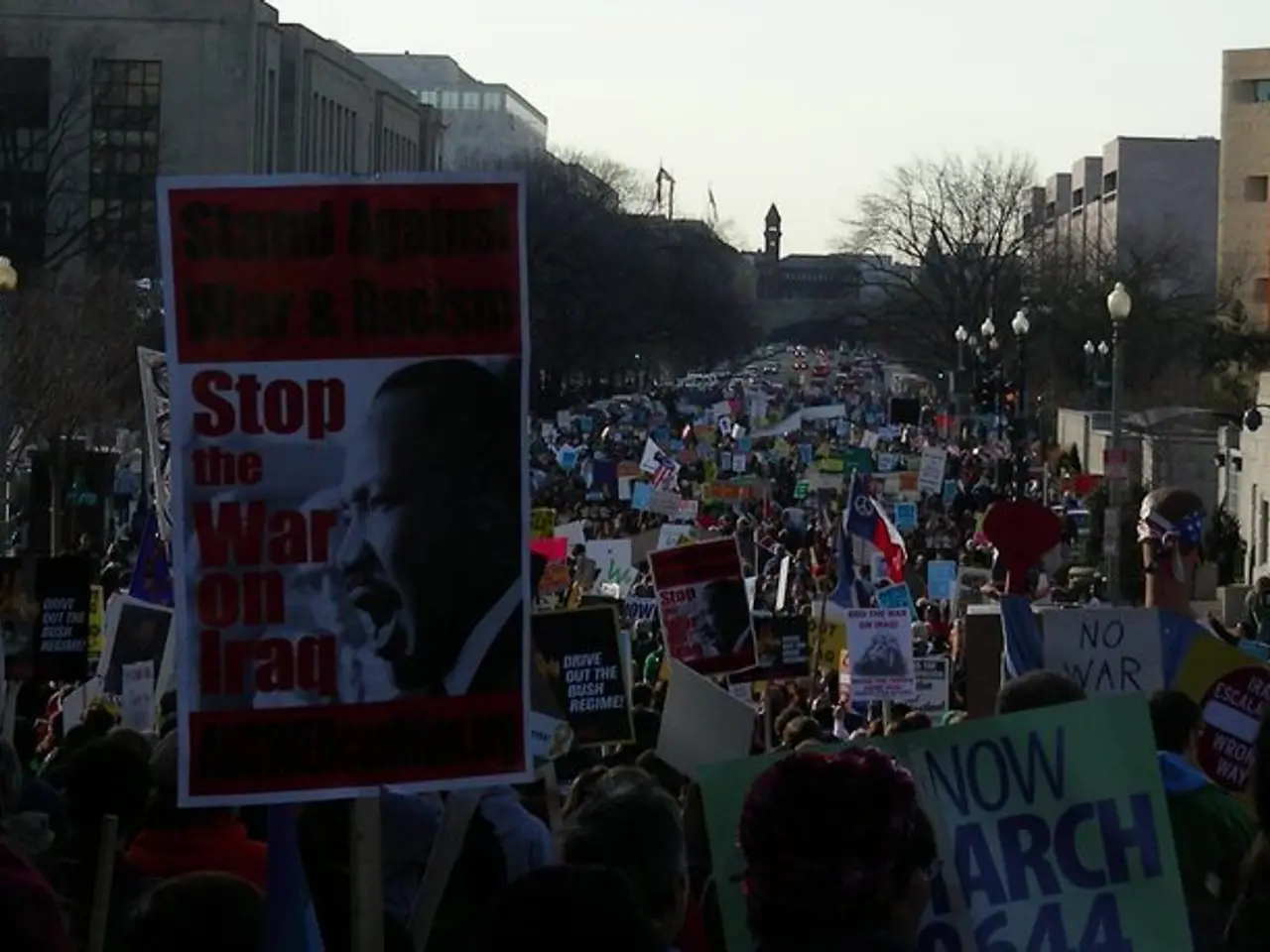
The far-right rallies have not gone unchallenged, with counter-demonstrations by civil society groups actively resisting xenophobic narratives. The media coverage of these events highlights the polarized public mood surrounding migration policies, with protesters calling for stricter border controls and critics accusing the government of encouraging xenophobic fears.
Government policies under President Donald Tusk have tightened immigration controls, leading to a rise in racist incidents and societal tensions. Immigrant worker unions have organized emergency legal assistance for those detained and facing deportation despite pending applications.
The Catholic Church in Poland is divided on the issue of migration, with some bishops supporting right-wing militias and others advocating for the prevention of hate speech. Bishop Wiesław Mering described the Polish government as "German" and stated that "the borders of our country are threatened from both the west and the east".
The far-right party Konfederacja has organized demonstrations against immigrants in several cities, primarily supported by football fans. The current Polish government is facing difficulty accommodating the New Left due to their stance on immigration.
The Polish Ministry of Foreign Affairs has sent an official note to the Vatican regarding statements made by two bishops, urging the Church to refrain from interfering in the internal affairs of the state. The position of Minister for Equality was abolished by Tusk in the government reshuffle.
Recent xenophobic incidents include a racially motivated attack in Częstochowa, where a 30-year-old man attempted to stab a black guest in a bar. The activist group "Zjednoczeni Przeciw Rasizmowi" (United Against Racism) has accused Poland of complicity in the chaos in the Middle East due to its participation in the "shameful invasion of Iraq" twenty years ago.
In response to these developments, the Bishop Antonin Długosz has supported right-wing militias by praying for the defenders of the borders. The same activist from "Zjednoczeni Przeciw Rasizmowi" also stated that there is no place for fascism in Warsaw, a city that was severely affected by fascists.
Katarzyna Kotula, the former Minister for Equality, will continue to work on the draft bill on civil partnerships in a lower position. The Tusk government has suspended the right to asylum for the third time in a row, a decision approved by parliament. The word "engineer" in Poland is being used as a derogatory term for people with non-white skin color who come from other countries.
As Poland navigates these challenging times, the nation remains divided, with some calling for change and others clinging to traditional values. The ongoing debate over migration policies and the rise of xenophobia are shaping the political landscape of the country, and it remains to be seen how these issues will be resolved in the coming months.
- Science and technology discussions have taken a backseat amidst the surge of xenophobic activism in Poland.
- Lifestyle choices are increasingly becoming politicized, with a growing emphasis on immigration policies.
- Fashion-and-beauty trends are overshadowed as the nation grapples with the rise of far-right groups.
- The surge in xenophobia has led to an increased demand for books on tolerance and inclusivity.
- Education-and-self-development resources are focusing more on personal growth and mindfulness.
- The escalating national debate has also impacted casino-and-gambling, with less talk about casino-games like blackjack and poker.
- Social-media platforms are buzzing with opinions on the xenophobic activism, fueling both support and opposition.
- More people are turning to entertainment such as movies-and-tv for escapism from the tense political climate.
- Productivity and career-development strategies are being shelved as people grapple with the uncertainties of the political landscape.
- The rise of far-right groups in Poland has caught the attention of casino-gaming enthusiasts worldwide, sparking concerns about the future of the gaming industry.
- The trending news topics include the rise of far-right groups and the impact on Poland's political landscape.
- Crime-and-justice reports have detailed incidents of hate speech and racist attacks linked to the far-right rallies.
- The ongoing car-accidents caused by the marches have raised safety concerns across the country.
- The hard-hitting music, especially songs on pop-culture and sci-fi-and-fantasy, are resonating with people who seek a voice against xenophobia.
- Online-education resources are offering courses on understanding and combating xenophobia to help people navigate these challenging times.
- Job-search platforms are seeing a rise in demand for job opportunities that align with the anti-xenophobic movement.
- Sports leagues, such as the Champions League, NFL, WNBA, baseball, hockey, golf, and tennis, are taking a stand against xenophobia, raising awareness and funds for affected communities.
- Sports-betting enthusiasts are reconsidering their choices, with some avoiding European leagues and focusing on non-political games like mixed-martial-arts.
- Basketball leagues, such as the NBA, NCAA-Basketball, MLB, NHL, and racing events like the premier-league, American football, and F1 Grand Prix, are speaking out against xenophobic rhetoric.
- Tennis matches and events are serving as platforms for open discussions on the rise of xenophobia and moves towards tolerance.
- Sports analysts are closely following the developments in Poland, providing insights on the impact of the rise of far-right groups on sports and society.
- Auto-racing events, such as horse-racing and NASCAR, are not immune to the controversy, with some sponsors pulling out in protest against the xenophobic movements.
- Mixed-martial-arts organizations have taken a stance against xenophobia, promising to combat any instances of racist behavior within their community.
- The ongoing political tensions in Poland are affecting general-news topics, overshadowing other issues such as the economy and foreign policy.
- The grave consequences of xenophobia, including fires and accidents, are causing widespread concern among Poland's citizens.
- Learning about the importance of goal-setting and lifelong-learning has become crucial as people strive to overcome the challenges posed by rising xenophobia.
- Skills-training programs are offering courses on effective communication and empathy to help bridge the divides in Poland's society.
- Sports leagues worldwide are monitoring the situation in Poland, hoping for a resolution that promotes tolerance and unity.
- As Poland faces these challenges, the nation is learning valuable lessons about the power of empathy, resilience, and unity in the face of adversity.




